Why Choose a Board-Certified Plastic Surgeon
Choose a board-certified plastic surgeon and be confident you are in the care of a highly trained surgeon you can trust.
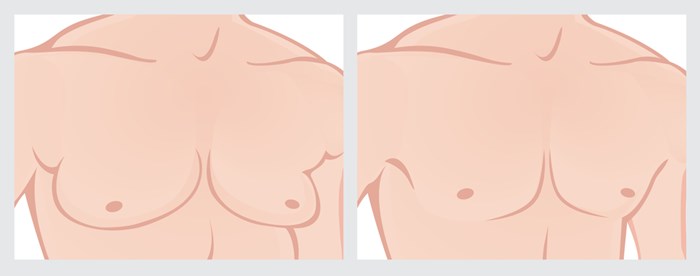
Gynecomastia after weight loss often requires longer incisions and more contouring due to the presence of redundant skin, tissue, and fat. The goal is to create a masculine, natural-looking chest in which the scars are positioned discreetly.
Gynecomastia surgery, or more commonly referred to as male breast reduction, comes in different techniques based on the scar appearance. However, massive weight loss patients should accept that they need an extensive amount of work to achieve good results.
Most gynecomastia surgeries use a U-shaped incision within the lower border of the areola (about 4 to 8 o'clock) so the resulting scars blend in with the skin. With this technique, doctors are able to remove the excess glandular tissue.
However, only men with a young, elastic skin can reap the benefits of a U-shaped incision technique. MWL patients, meanwhile, generally have more redundant skin that must be removed to achieve the ideal masculine contour.
In severe cases of gynecomastia, the patient may need an anchor reduction technique in which the incisions go around the areola's border, vertically down to the inframammary fold, and within the breast crease, leading to an inverted T-shaped scar.
Despite the more visible scar (especially the vertical line between the areola and the submammary fold), MWL patients should accept that it is the only way to achieve the optimal breast shape.
In the first few months, the scars will appear red and will continue to improve within a year. Oftentimes, they heal very nicely that their appearance will not bother most patients, as suggested by some Los Angeles plastic surgery experts.
However, a few may develop hypertrophic or keloid scars. Aside from genetic predisposition, studies have suggested that previous surgery results, family history, and skin color are risk factors as well.
Nevertheless, some risk factors such as wound tension and infection can be controlled, if not eliminated.
Proper wound closure such as deep suturing technique to minimize tension on the skin is one way to promote good healing and favorable scarring. To further support and protect the incision site, some doctors also use steri-strips.
Once the wound is clinically healed, steri-strips are then replaced by silicone tapes that hydrate the skin and prevent scar tissue (keloids/hypertrophic scars) from forming within the dermis.
Other ways to promote fine scars include scar massage, steroid injection, laser treatments, and surgical scar revision, which is viewed as the last option as it entails another incision.
For more information, including a list of ASPS plastic surgeons in your community, please use our Find a Plastic Surgeon tool.
The views expressed in this blog are those of the author and do not necessarily reflect the opinions of the American Society of Plastic Surgeons.